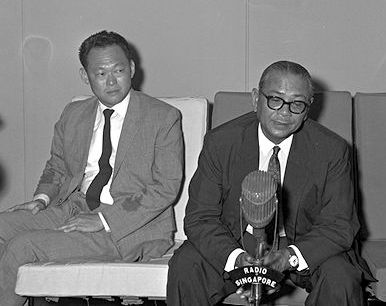
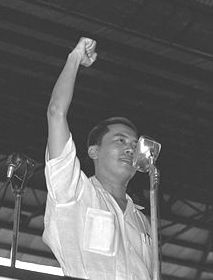
Tribute to Lim Kim San
 Another great founding father has passed us, Mr Lim Kim San. He passed away peaceful on Thursday, 5.30 pm, at his Dalvey Road residence. The Straits Times and other major local papers have listed his many achievements in HDB, Ministry of National Development, MAS, PUB, PSA, SPH and the Council of Presidential Advisers. Deservingly so. The list of achievements can go on and on for Lim Kim San but, undoubtedly, he will always be remembered as the man who gave us shelter with the creation of the HDB. With his leadership, Singapore is one of the rare success stories of public housing. Another label that he will always be remembered by is his ability to spot talents and judge one’s character and integrity. Rather than duplicating what most papers are writing by stating his childhood, life and achievements, I’d just add in some of his comments in an interview conducted in 1996 with Melanie Chew. By his quotes, one could feel the personal touch of Lim Kim San and his unwavering commitment towards the Singapore Story.
Qn: You were strictly volunteer. You were not paid at all. (With reference to Lim Kim San joining the the PSC and HDB as a volunteer in 1959)
Lim Kim San: Yes, Although I was the Chairman of the Housing Board, I was just a volunteer. I didn’t get paid a cent. Largely because Ong Eng Guan was the Minister. I thought that if I go in there and get paid, first it is not fair because I have my own business. Secondly, if I am a paid employee, he can kick me out! If I don’t like it, I could just lump it.
I had my reservations about Ong Eng Guan. I felt he was a megalomaniac and rabble-rouser. Well, I explained my feelings about him to the Cabinet, and they scolded me! “He knows Three Kingdoms!” they said. “Can you speak Hokkien like him?” Well, my feelings were proved correct.
Qn: It must have been quite a step, to volunteer to serve in the HDB. The HDB and the building of low-cost housing was a central pillar of the PAP government. It was a huge job, a demanding job. And you took it on as a volunteer!
On reflection, I think it is a case of “fools rushing in where angels fear to tread.” But when you are young, you feel everything is possible.
But there was another reason. Have you heard of a street called Upper Nanjing Street? I went down there to look at the housing conditions for the poor. What a shocking experience it was! I have never been down to that part of Singapore. Of course, I had passed by in the car but I have never been inside the houses.
I went into a three storey shophouse with one lavatory and two bathrooms. We countered 200 tenants living there. It was so dark and damp. It was an inhuman and degrading existence. I saw for myself how really poor they were.
Underneath the staircase was a single plank. A man was lying on the plank. He had rented it. That was his home! And he was lying down covered by a blanket made in China. I paused and asked him if he was sick. “Why are you covering yourself with a thick blanket?” He replied, “I am covering myself out of respect for you. I am wearing only undershorts. My brother is wearing my pants.” They were too poor to afford clothing. In those days, there were shops which pulled clothing and shoes off the dead to sell them. “My God,” I thought to myself, “I must really help these people.”
Qn: You did not begrudge the amount of time you spent in HDB? I am sure there was sacrifice of your time and effort. Did you own business suffer?
When you are working hard and enjoying what you do, you don’t think of it. I am doing something that needs to be done and, in the process I am enjoying myself. Anyway, my own business needed very little minding. Once I don’t owe people money I don’t worry.
Qn: How did you build so quickly?
Firstly, we were never denied of funds from the government. We had a very high priority project.
Secondly, I broke the hold of the bureaucracy. The Singapore Improvement Trust worked by committees. God knows, they had ten or 15 committees, I abolished the whole lot. I said, “I’m the Committee.” There was a secretary there who would give me many reasons why things couldn’t be done. He would cite this law and that law and this Committee and that Committee. I had to get rid of him.
And in fact, if I don’t like a project and I’m pressed to do it, I form a Committee. That really slows things down and sometimes the project just dies.
We broke through all the red tape. No red tape. As I said, “I’m the Committee.”
Qn: What was your formula? What made the HDB so very successful?
In any organization that one goes into, the first few decisions are the most important. If taken correctly, they will set you on the right road. I think there were three important decisions which we made in those early days which enabled us to build 10,000 units a year.
First, we broke the hold contractors’ cartels. Secondly, we decided to do our own earthworks. There were only two companies doing earthworks, Gammons and United Engineers. So every time we asked them to do the earthworks to prepare the site, they said it would take six months. I said, “That won’t do.” We decided to do it ourselves. I had a friend who was a contractor. He later became the Chairman of the Public Service Commission, Tan Teck Chwee. I asked him, “Hey, what’s the problem with earthworks? Why does it take so long?” He said, “No problem. I’ll show you how it’s done.” So he did. And then we did our own earthworks and saved valuable time. I would put that as the number two decision.
The third decision was standardization. You know, we used standardized concrete slabs. Standardization made it so much easier to design and faster to build. We also made specifications which we knew were realistic and could be achieved. Plus we made sure that contractors fulfilled the specifications. We went around, inspecting all the buildings very closely to make sure that the contractors fulfilled the specifications. We kept contractors under very close supervision. Yet we managed to keep the quality relatively high through strict supervision.
We had a good competent team, earnest, and honest. Through inexperienced, they were energetic and capable. They showed great interest in the work and by that, stimulated each other. They challenged each other.
Qn: You were a volunteer all that time?
Yes, until 1963, when I became a Minister.
Qn: So for four years you gave your time voluntarily.
Yes! I should have asked to be paid one dollar, and then I could claimed a pension. At that time these things don’t occur to you at all! In fact, I asked for a driver because I was going all over the place, driving all over Singapore. So I asked for a driver. And they said, “You are not a paid employee, you don’t get a driver.” So I had to drive myself. (Laughs)
Qn: What about the statutory boards? You served on the PSC and HDB. Then, after that, the PUB and the PSA.
Yes, I think I did my most satisfying work in the statutory boards. In the ministries you do policy-making. In the statutory boards, you really get involved in implementation. I like to get involved with detailed work. I also like to do several jobs simultaneously. I ran Ministries and statutory boards concurrently. Everyday, I would spend time with several projects. I like that. Otherwise, I would get board. I can’t sit still.
Qn: What was your major task in the PUB & PSA?
It was to build reservoirs, to make ourselves more self sufficient in water. So we would be less dependent. I built Upper Pierce, Seletar, all those reservoirs.
The PSA appointment was because of my own big mouth. I saw PSA building the World Trade Centre for 5,000 people. I thought it was not a good time or place. Well, the lifts were so inadequate, they would have taken all day to get 5,000 people to the top. So I opened my big mouth and before I knew it Prime Minister had put me there as Chairman! Well, it was as interesting post. Within one week, I had ordered 110 million dollars worth of port handling equipment. That was a lot of money in those days. Again, by listening to the experts, I discovered that we were short of handling equipment.
I also redirected the PSA back to its core business. The PSA had containerized its port thanks to Howe Yoon Chong. He was a very good man. He could really get things done. We were already the second busiest port in the world, after Hong Kong. We had overtaken Rotterdam.
One problem we had to face was our very limited cargo handling area. So we had to have computerized handling of cargo, so that we could stack containers six units high. No other port does that! But this requires very sophisticated handling systems. Each container has a computerized tag which says where it is going. The container passes through a gantry and the tag is registered. We know where each container is any time. Incidentally, we used this technology as the basis for the Automatic Road Pricing scheme.
Qn: How did you approach each statutory board? Each was so different in nature.
My job was to get the organization going, build a team, and then leave.
Qn: And you held so many positions! I can’t imagine how you managed to juggle all these jobs!
Oh, well, I probably have a grasshopper mind. It helps! The whole thing boils down to two things: understanding your objective, and man-management. Whether you are in big ministry, or statutory authority, or in Singapore Press Holdings, it is a question of man-management.
Qn: You do it so well! Do you have a policy?
My policy is roughly this: I am not a specialist at anything. Neither am I a professional. But I listen to the specialist and the professional. The electrical engineer, the quality surveyor, the architects. And they may have different points of view. I am open and I listen, and allow them to express their views and opinions.
I use my common sense to ask questions, like “How about this or that?” If they cannot agree, them I must myself decide. But most of the time, if you sit down, talk, listen and discuss, you are likely to find a solution.
But the whole thing is this: listen to people. I listen to them, and I know that this chap can be trusted, he knows his work. Then I leave him alone. He will grow! Instead of me telling him what to do. He is the man who runs the show! He will make suggestions to be to ponder, “Is it OK?” If it is OK, I say, “Proceed.”
Qn: Then you leave him to it?
I leave him! And then he will grow! If I look over his shoulder, well, who am i? I know nothing of that job.
Qn: How do you deal with mistakes?
I always tell my officers that if they do things within the agreed responsibilities, and they make an honest mistake, a genuine mistake, without any vested interest – I’ll back them up all the way. If you back your people, even when they make mistakes, they will learn from their mistakes! Furthermore, they will also learn to make decisions by themselves.
But if you pick up on their mistakes and bawl them out, they will never make another decision again. All decisions will land up on your desk and you will never build your organization.
If they make too many mistakes, however, maybe they don’t deserve the job and you should get rid of them.
Qn: What are your shortcomings as a manager? What do you feel needs improvements?
Lack of patience! But age and experience have mellowed me. Now, I listen more.
But if you are sitting at the top, you must be unpleasant sometimes. Disciplining is never pleasant. Once I called up a chap and said, “You just get out.” He said, “Why?” I said, “You didn’t do your work, that’s why.”
It has to be done. When I was in the PSC, I used to go through thousands of personnel annual reports and not find a single adverse or unsatisfactory report. It is our Eastern way. We don’t want to be unpleasant or break anyone’s rice bowl. But if you are at the top, you must have to courage to speak out when things are wrong.
I can be short tempered and impatient. If you act unreasonably or dishonestly, I will throw you out of my office! I remember a delegation came to see me to ask for tax exemptions for traders. Well, Singapore is a trading economy. Why should they be exempt? I was so fed up. I was wearing a neck collar at that time because I had injured my neck. I took the thing off and threw at them!
Qn: In the 80’s you became known as the government talent scout.
Yes
Qn: How did you learn to judge people?
I think that comes from experience. To me, it is instinctive. You listen to the chap talk and you think, “The chap is quite alright,” or “This chap, you can’t trust him.” I think all successful businessmen have that kind of instinct. You meet a chap, you make a deal. You feel you can rely on this man. He’s on the level. You can trust him. For me, it’s quite instinctive.
Sometimes I shake the guy by the hand and I feel revolted. I feel like throwing off the hand. And you look into his record, you find that, sure enough, this man has done something wrong. Have you heard of Slater Walker? I told the Cabinet to stop them from coming into Singapore. They said to me, “You have a suspicious mind!” Businessmen must have such an instinct.
Qn: Have you made bad judgments? Have you trusted people and later, found yourself wrong?
Not in a big way. Not in a big way. Because if I try out a chap I don’t give him the whole project. I watch his progress. I have some nephews who have spent many years running the business. I watch them and halfway through, I know. if they cannot handle nig things, I put them elsewhere. So it is a question of watching and observing.
It’s the same in government. You ask me, how do I find leaders? You don’t. Or rather, you cannot. You can only spot potential leaders.
First and foremost, I’ll look for an intelligent man. Secondly, I look for a man who has a social conscience. Maybe they were giver a chance to progress, for example, a scholarship.
Some of the Ministers that I interviewed felt that they must somehow repay society for the opportunity given by the government or institutions to further their studies. Some of them were very poor. They were given a chance to progress. Now, they wanted to do something in return. Of course, they may not be sincere. But you watch them to see whether they are sincere.
And I look for people with robust health. Because politics is a strenuous thing. In politics, you are under pressure every day. I don’t know what it is like now, but in our time this was the case. You must be able to take it. I have seen chaps literally going mad before my very eyes. They could not take the pressure. Yes!
But in the end, as one General has said, you will never know the man until he is in the firing line. People whom you think will stand, will run. Wait until crisis and you will know!
Qn: Is the problem that we now that we have too little crisis? You have no chance to observe people under crisis?
You need not have a full-blown crisis. You just watch them working under pressure. There are certain policies which are unpleasant to carry out. You make them do it and you can see. Can he take criticism? Can he stand up to it? Can he fight back? Nothing like trying the man on the spot. I also know many men who are very good as number two. But as number one, they fail.
Qn: Why was the Civil Service in Singapore able to function so well without the problems of corruption, red tape and bureaucracy that plague some other countries?
The civil service was something inherited from the British, and at that time the British were known for their honesty. So I think the tradition was there and it was a matter of continuing it.
Out leaders were honest. So if you have honest leaders, the civil service will be honest. If anyone is corrupt, they will get punished. But if you have corrupt leaders, the civil service will just follow suit.
Qn: So the key to getting rid of corruption is to have honest leadership.
Yes! To set the example. Yes! And anyway, now the civil services are so well paid, why would they bother being corrupt? Well, perhaps, you can’t say. Some people can have all the money in the world and they will still be corrupt.
Qn: You have an instinct, which you have derived over many years of experience. If you have to make it into a system, which someone else can apply, how would you do it?
Look for an intelligent person. Look for someone with commitment. With very good health. Someone who shows interest in things. Some people are very narrow. When you see some chap who is very interested in things, possessing an inquisitive, enquiring mind, well, he has the potential.
Mind you, these persons have potential only. You cannot pick them up straight away. They just have potential. You’ll be lucky if you can get three out of ten.
Qn: If you had stayed out of politics, would you have made more money?
I would have.
Qn: It’s been a sacrifice for you.
Well, I cannot ear more than what I eat now. I have enough. I cannot use more. I am quite happy. I don’t want to be the richest man in Singapore. I could possibly have made more money.
You know, some of my Cabinet colleagues were bitter about having to retire. No one gives up power voluntarily. Myself, I was not disappointed. What did it mean to retire? I had to carry my own bags. No one hailed me on the street. Never mind!
I look at it this way: I was given a chance to serve my country. How many people are given this chance? I was fortunate to have been a part of the team which built Singapore. I had some skill and some strength that was useful to others.
To serve your country is a privilege. It is an honour. I am very proud to be able to say, “I have served my country.”
Qn: Do you have any regrets?
No, my only regret is that I should have taken more pains with my work. I did many things in a rush. I should have taken more time to think things through. Well, even working in my rushed fashion, I did not commit many major mistakes. But if I had taken more time, and given more thought to everything, I would have done my job better.


 Upon an anonymous suggestion, I’ve decided to write something and some thoughts on the National Day Rally (NDR). Since many of us are sick of the “aerial” and “ground bombardment” of post-NDRs, I should write something different about this year’s NDR. Perhaps before starting on any thoughts it might be interesting (things that I’ve found boring was interesting to the readers and vice versa, so when I say its interesting, it might be boring! Readers beware!) to have some fun facts on the NDR.
 This one is really curved-ball and has to do with SM Goh. Traditionally, just before the start of every rally, all will be seated before MM Lee Kuan Yew enter the hall to a rousing applause by all. The past two NDRs, SM Goh entered just before MM Lee and was received by applauses from the audiences. This year’s National Day Rally, GCT entered the hall with no one applauding him despite him turning around to face the audiences, expecting an applause. He intended to wave at the audience, but given the zero response, he turned back, sat down and didn’t move until to the Rally ended. Maybe he met with tough audiences or was just a victim falling from grace. But you could sense and see his disappointment. After the Rally, GCT was with Mah Bow Tan chatting about their perception on the youth near the buffet table. From my “eavesdropping”, I believed they weren’t talking about his non-applause. ;)
 Unlike last year, when David Lim (former Acting Minister for MICA) walked across the whole front row Cabinet Ministers without any eye contact and smile from both parties, this year’s former Ministers faired better. Former DPM Dr Tony Tan had a lengthy conversation with now DPM Wong Kan Seng just before the Rally started and was well-received by all Ministers and MP. Former Transport Minister Yeo Cheow Tong had some mixed reactions. He was largely ignored by some Ministers (DPM Wong Kan Seng rather focus on his mobile phone than to look at his ex-colleague) but was greeted with smiles by some others like the ever-friendly Lim Swee Say, Lee Boon Yang and Teo Chee Hean. Only Dr Balaji Sadasivan, literately and physically, bent backwards to shake Yeo Cheow Tong’s hand.
 This is something good-to-know if you ever get invited to National Day Rally. Traditionally, there will be receptions (of course with food) before and after the Rally where the Ministers and MP mingled with the attendees. But there is an implicit observation that many don’t see. Grassroots and Party (PAP of course) cadres are usually invited to the rallies. And Ministers and MPs will also gather with their constituency members for discussions and chitchats. Occasionally, the Ministers will be talking among each other on work related issues or with prominent businessmen. But most of the time, they will be with their own grassroots. Before going to that, just some quick observations. Dr Vivian was seen with DPM Jayakumar, Mah Bow Tan with SM Goh and Lim Hng Kiang was with Kwek Leng Joo, the Managing Director of City Development Limited (CDL) – formerly in the running for the Marina IR with Las Vegas Sands. Now for the main course: what is the implicit message?
 PM and the rest of the senior leaders will also be at the reception to mingle with the crowd. But sometimes, what is evident is that this is one of the occasions to assess how well supported are the Ministers and MPs by their grassroots. Every NDR, there are two areas for reception, the second floor and the first floor. For the MPs and Ministers to get maximum exposure, they will usually be at the floor where the PM is. Second floor is a lot quieter. But those Ministers and MPs who are not too concern over this will visit the second floor to mingle. Some spotted at the second floor includes, Foreign Minister George Yeo, Senior Minister of State Dr Balaji Sadasivan and MP Wee Siew Kim. {See Photo: PM Lee is in red shirt with back facing the camera. Can you spot the other Minister "near" him?}
 In the past three National Day Rally by LHL, only one Minister was mentioned in every of his speech: Education Minister Tharman Shanmugaratnam. Each time, the comment regarding Tharman was directed on their seemingly casual conversations. Perhaps he was consulted often by the PM and might be groomed for greatness. Aside from the commonly mentioned Ministers, there are also the “punts intended”. In this year’s NDR translation from his Chinese speech, he mentioned this, “Two years ago, we introduced major policy changes to encourage couples to have more babies. So far the results have been very modest.” Two years ago, Lim Hng Kiang was the Minister-in-Charge of the birth rates policies. Punts intended? Maybe. Given the amount of budget spent on improving the birth rates, he has done quite an abysmal job. But in the first place, this task was not something that one could easily manage and be done within two years. In other words, this is quite a suicidal task.
 Political science lesson 201: Every policy needs a “face”. This means that for every policy, some ministers must take responsibility or take the face of it. Name any policy, and you should or must be able to find a face to it. Like Goh Chok Tong’s initiative of the CPF cuts during the economic downturn, George Yeo to FTAs, or the building of MRT to Ong Teng Cheong’s credit, are the faces of the policies. So far, Lee Hsien Loong has been elusive in doing that, rightly so. Since taking on the post of Prime Minister, he has been careful in avoiding putting his face on any policies, except the IR. I don’t think that he is trying to sidestep any responsibility or controversy but is a deliberate strategy to strengthen his hold on his leadership.
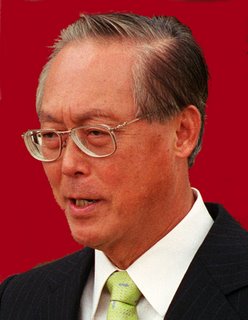 In this article, I’ll be writing on a recent and continuing history of SM Goh Chok Tong with a slight twist. There are little doubts that he was a popular PM in comparison with his predecessor and successor. His “softer” approach and style was a breath of fresh air to many. Upon his stepping down from his premiership, there have been many articles written on his policies, his leadership and his achievements. This will not be one of them. Simply, if I do write on those standard contents, you will be better off reading the Straits Times than this lengthy blasphemy (not that Straits Times always purport the unbiased truth!).
 Anyway, many of policies made within the Cabinet are not unanimous. That is politics; the innate and unseen character of each participating entity. Of course, like what Lim Kim San mentioned about assessing people is that one could only briefly know the other person through observation and instinct. This is what made assessing politicians so difficult. In the public face and media spotlight, we thought we know them like friends but there are more that we don’t know than we thought we know. The resulting impact is that we place mental and perception brackets on their names, like Lee Kuan Yew (the Authoritarian), Goh Chok Tong (the Good Guy) and the Cabinet (the group of “Yes-men”) based on what the media feeds to us. This article (or blasphemy, depending on how you see it) will just add fuel for your thoughts with statements from GCT and on GCT. Ultimately, this blog can’t claim to know or speak the unspoken truth on GCT or any politicians, but just form an alternative perception track. I’ll leave you to make your own conclusions.
 First, we must know that LKY’s book was an international bestseller across many countries, and read by most leaders around the world. Second fact is that whatever he wrote in his book about GCT or LHL would be what foreign leaders read about them. In that chapter, he described GCT as “not a natural politician…tall, gangling and awkward, and spoke English with a heavy Hokkien accent.” This is not the best description for the person who is about to succeed you. LKY also described GCT as “self-conscious and without the gift of speech-making but had ability, dedication and drive, and was interested in people”. Later LKY even mentioned that he found an English women to teach GCT to speak in a more relaxed and natural way. For a person who will be Prime Minister, he still needed someone to assist him to look for a tutor? This might have pointed out that GCT wasn’t really in the “driving seat” but had an instructor beside him, constantly.
 Another interesting point to the chapter was GCT not wanting move into LKY’s office. “I did not suffer any withdrawal syndrome. Chok Tong did not want to move into my old office in the Istana Annexe, which I had occupied for 20 years since I moved from City Hall, but chose to create a new office on the floor above mine.” Aside from the niceties that one might think of when he first read it, there might be more significance in that statement. Maybe LKY was literately the “power behind the throne”, or maybe it suggested how much power LKY had and wish to remind GCT about it. More importantly, what is the message that LKY wants to bring to all the leaders in the world about his deputy?
 However, his first GE (1991) was setback from him and probably changed his “election personality” several degrees. In the 1991 GE, the PAP lost a record of 4 seats to the opposition, one of which was his female Senior Minister of State, Seet Ai Mee. Other wards, such as Bukit Batok, were barely won by the PAP. That election was the turning point of his “election mentality”. Since then, he has opted to be tougher during elections with his words and actions.
 The world has seen plenty of examples of the difficult relationships between the leaders and their deputies. All these incidents led both LKY and GCT to rethink their own potentially precarious position. No matter what LKY said, deep down, he wanted LHL to be the Prime Minister someday. And he could only exert his influence if he is still in Cabinet. And for GCT, he knows what LKY wants from him and knows that LKY still has the ability and power to remove him should there be a need to. This is a tango that both are dancing in secret. Given their delicate relationship, it is not surprising to see GCT echoing most of LKY views and words. If you look through all the news reports on GCT, majority of his words are singing in the same tune as what LKY previously sung. In the opinions of many, GCT never really stepped out of LKY’s shadow.
 One question that no one explicitly asked was whether the system and post of Senior Minister would exist when LKY passes. The current situation, of having two former Prime Ministers in the present Cabinet (plus the present PM), is unprecedented in any part of the world. Since it currently exists, the question should really be whether it should continue to exist and will it cease to exist. There are some coffeeshop talks on this issue that before LKY passes, GCT will either step down or have his loyal men removed. (According to market talks) Given LKY sensitive nature developed during the tumultuous times (see the History of PAP) and struggle of the traumatic party split, he will leave nothing to chance. Although the possibilities of a party split or power struggle is negligible, he will not rest until that has been resolved even after his death.
 For LHL’s team to be effective, it is vital and necessary for him to place his people into the key Ministries. As predicted before the GE 2006, I expected Yeo Cheow Tong, Lee Boon Yang and Lim Boon Heng to gradually step down (within one year) and it is taking shape now. Yeo Cheow Tong has stepped down, and both Lee Boon Yang and Lim Boon Heng have indicted their stepping down within a year. MPs loyal to GCT like Dr Tan Cheng Bock (Golf partner of GCT) have also stepped down. For GCT himself, he has been assigned to foreign and finance affairs issues such as Middle East Islamic finance hub and Malaysia bilateral issues. This isolates his impact on “domestic politics”, leading him away from the public eye and leaving room for LHL in the spotlight. Again, there is nothing wrong with that, all in the name of “renewal”.
 GCT openly challenged the opposition parties to test Marine Parade GRC (his ward). Yes, all MPs and Ministers also challenged or stated that they welcomed opposition contest. But for GCT, it was different. He needed the contest to demonstrate that he is still more popular than LHL, something which he is sure of but required undisputable figures. If he scored well in the contest, it might prolong his career in LHL’s administration or (very remotely and speculatively) offer him a chance of a comeback (which GCT himself wouldn’t even expect or probably want). But he didn’t receive a contest and it turned out worse.
 If (1) happens, LHL will be credited for winning back the PP and Hougang but not GCT, since GCT was not able to do it when he was PM. But the government will run into lots of foreign affairs (such as democracy advocators) issues of having no oppositions in parliament (inter-parliamentary visits require oppositions as well).